Scatter Min
-
torch_scatter.scatter_min(src, index, dim=-1, out=None, dim_size=None, fill_value=None)[source]¶ 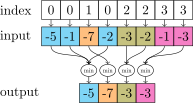
Minimizes all values from the
srctensor intooutat the indices specified in theindextensor along a given axisdim.If multiple indices reference the same location, their contributions minimize (cf.scatter_add()). The second return tensor contains index location insrcof each minimum value (known as argmin).For one-dimensional tensors, the operation computes
\[\mathrm{out}_i = \min(\mathrm{out}_i, \min_j(\mathrm{src}_j))\]where \(\min_j\) is over \(j\) such that \(\mathrm{index}_j = i\).
Parameters: - src (Tensor) – The source tensor.
- index (LongTensor) – The indices of elements to scatter.
- dim (int, optional) – The axis along which to index.
(default:
-1) - out (Tensor, optional) – The destination tensor. (default:
None) - dim_size (int, optional) – If
outis not given, automatically create output with sizedim_sizeat dimensiondim. Ifdim_sizeis not given, a minimal sized output tensor is returned. (default:None) - fill_value (int, optional) – If
outis not given, automatically fill output tensor withfill_value. (default:None) - fill_value – If
outis not given, automatically fill output tensor withfill_value. If set toNone, the output tensor is filled with the greatest possible value ofsrc.dtype. (default:None)
Return type: (
Tensor,LongTensor)from torch_scatter import scatter_min src = torch.Tensor([[-2, 0, -1, -4, -3], [0, -2, -1, -3, -4]]) index = torch.tensor([[ 4, 5, 4, 2, 3], [0, 0, 2, 2, 1]]) out = src.new_zeros((2, 6)) out, argmin = scatter_min(src, index, out=out) print(out) print(argmin)
tensor([[ 0.,  0., -4., -3., -2.,  0.],
        [-2., -4., -3.,  0.,  0.,  0.]])
tensor([[-1, -1,  3,  4,  0,  1],
        [ 1,  4,  3, -1, -1, -1]])